
Sheffield’s hard and deep tech universe
From the report, p36
Sheffield’s Hard & Deep Tech companies tend to be funded by venture capital rather than debt, developing technologies that solve difficult problems or enable magnitudes higher performance. They serve therefore as enabling technologies, often embedded in a larger system, and which can be transformational.p36
A cluster that has a strong hard & deep tech community can innovate more rapidly and deliver solutions that keep it ahead of its competitors. Successive governments have recognised that innovation of this type is central to the success of a modern economy, especially to an advanced manufacturing cluster.p36
Deep tech requires fundamental engineering knowledge that relies on mathematics, physical sciences and computer sciences. Such disciplines provide the core capabilities behind valuable technologies such as machine learning, AI, cryptography, semiconductors and AR/VR.p36
What Bessemer Society regular, Stan Boland, is seeing in Sheffield is not a software cluster or a digital agency scene, but the early formation of a genuine cluster built on physics, materials science, and engineering, the kind of cluster that nurtured his own career in and around Cambridge.p36
The challenge for Sheffield is whether it can attract enough capital, retain the right talent, and build a robust hard and deep tech institutional ecosystem to reach the critical mass that converts good research into durable companies rather than seeing its best spinouts exit or relocate southward to the Golden Triangle.p36
Boland’s investment in Phlux Technology is a paradigm case of his thesis: a company tackling a genuinely hard materials science problem (antimony-based infrared sensors, unsolved for over two decades) that emerged from world-class specialist research at the University of Sheffield’s III-V semiconductor research department. The problem is hard enough that the competitive moat, once the technology is commercialised, is substantial. The researchers involved spent over ten years on the underlying science.p36
Today Sheffield outfits like Phlux, Exciting Instruments, Aegiq, Sitehop and Opteran are the vanguard of this deep and hard tech movement. To help support it further, the Royal Academy of Engineering, which has enterprise hubs in six cities outside London, has established one in Sheffield with the express aim to “support local engineering and technology innovators and entrepreneurs with equity-free funding, smart and flexible training and mentoring from industry experts.”p36
The deep and hard tech vanguard
From the report, pp37-38
 Exciting Instruments (opens in a new tab): single-molecule detection, developed from spectroscopy collaboration at Sheffield University.
 Aegiq (opens in a new tab): photonic quantum computing, drawing on over 20 years of research in quantum photonics.
 Tribosonics (opens in a new tab): automated sensing for valves, seals and pumps to reduce friction-induced wear.
 Phlux Technology (opens in a new tab): infrared sensing technologies for the communications industry.
 M2i2 (opens in a new tab): predictive, physics-based modelling using AI.
 Opteran Technologies (opens in a new tab): natural intelligence autonomy software for robots and drones, mimicking insect brains.
 Cumulus Energy (opens in a new tab): rechargeable copper/zinc battery technology for grid-scale power storage.
 AmpliSi (opens in a new tab): a porous silicon anode to replace graphite in lithium-ion batteries.
 Pixel-Flo (opens in a new tab): a process for making micro-LEDs more manufacturable at mass-market price points.
 SiteHop (opens in a new tab): security measures to protect against future types of cyber-attacks.
Quantum leap
Aegiq’s journey is a good example of how Sheffield’s innovation ecosystem can support a deep tech company from its research foundations through to commercial scale-up. The company emerged from the University’s world-class quantum photonics and semiconductor expertise, and Technology Parks provided an important stepping stone from an academic environment to an independent commercial operation. The move allowed Aegiq to stay close to the University’s research base, with its specialist facilities and talent pipeline, while building the infrastructure, customer relationships and operational capability needed to serve global markets.p37
With its recent move to a new headquarters facility nearby it enters the next phase of the journey. This was facilitated by financial support from the South Yorkshire Mayoral Combined Authority, which recognises the importance of helping high profile technology success stories to become established. As a result, it now has the larger space and facilities it needs to scale. The next step is to complete a Series A expansion plan which will enable the company to grow towards a team of around 65 people. “The ambition”, says its co-founder and CEO, Scott Dufferweil, “is to build globally competitive quantum computing systems from Sheffield, using the UK’s strengths in photonics, compound semiconductors and advanced manufacturing to deliver real-world impact.”p37

Tribology meets data
In several cases the founder is a postdoc, such as Dr Phil Harper, who founded the company in 2006 based on his PhD research in ultrasonics. Sheffield is a leading centre in this field and Harper one of its leading experts. The company combines industrial sensing, tribology, and digital data measurement for companies that need to capture information about the performance of their assets. This is particularly relevant for large process plant, like chemical facilities and offshore oil and gas installations where costs of breakdown or malfunction are very high. Many of its customers are in the USA.pp37-38
The company’s main product, acoustoSENSE, is a pressure relief device (PRD), which helps pressure loss from valves and similar. With a total addressable market of 38 million PRD’s in industrial applications, Tribosonics has a rare opportunity to scale the business globally. Tribosonics carries out the design, development and testing of the required acoustic emissions sensors, electronics, firmware, software and data analytics. Component and sub-assembly manufacturing is done in-house in the early stages before scaling through supply chain partners. Its CEO, Mark Wallace, finds Sheffield a great place for the business, and the UK in general with its rich technological heritage, but scaling early stage hard-tech businesses in the UK remains a problem. This, as he adds, includes “regional capital distortions and exit paths.”p38

State of Phlux
Dr Ben White completed his PhD at Sheffield in 2016, researching semiconductor materials for photodetectors. Recognizing that traditional silicon-based sensors (used in LiDAR) had reached a performance plateau, he and his co-founders identified that by using Antimony-based materials the team could break the 20-year technology bottleneck in infrared sensing, with a long-term goal of becoming the “Nvidia of the sensor market”. In 2020, he was awarded a Royal Academy of Engineering Enterprise Fellowship. This helped propel the venture which raised a Series A round in March 2025 of £9M led by BGF.p38
The rise of deep and hard tech
According to data platform Dealroom, more than half of VC funding raised in Sheffield and the wider region since 2020 has gone to deep tech companies and around half of VC-backed companies are developing physical tech - hardware-software combinations used in manufacturing, logistics and agriculture. Deep tech has attracted £121 million in funding since 2022, making it the top-funded sector, with transportation, climate tech, energy, and fintech each exceeding £70 million. The Region on the rise: South Yorkshire’s pathway to scale report, published by TECH SY and Dealroom, notes that “physical tech and deep tech make up a greater share of South Yorkshire’s funding compared with the UK overall, reflecting the region’s strengths in advanced materials, engineering, and manufacturing‑led innovation”. It suggests Sheffield is “tracking at a similar enterprise value to where Helsinki and Pittsburgh were a decade ago”, and that the region’s tech strengths are “emerging.”p38
South Yorkshire and Pittsburgh
Explore the report’s comparison of South Yorkshire and Pittsburgh. The figures retain their original periods, units and qualifications.
Regional comparison
Report p39Both bars use the same scale: 0 to 2.5 million people. Figures are approximate, as stated in the report.
The report compares South Yorkshire with the Pittsburgh metropolitan area, rather than comparing the two cities alone.
The investment capital difference
Report p40South Yorkshire
Raised by startups
Since 2020
Pittsburgh
Raised in 2024 alone
The report gives an equivalent of £782 million using the ONS 2024 annual average exchange rate.
Different reporting periods and currencies. These figures are shown together as the report presents them, without a shared bar scale or a calculated funding multiple.
Investor relevant companies
Report p40South Yorkshire
VC-backed startups
Reported by TECH SY
Pittsburgh
Companies funded
Pittsburgh’s 2024 investment review
An ecosystem count and a one-year funding count measure different things. The report also notes uncertainty about the inclusion of CMU spinouts.
The university comparison
Report p40University of Sheffield
New spinouts
2025
University of Pittsburgh
New startup companies based on Pitt-developed IP
Fiscal year 2025
The reporting periods and definitions are retained. Carnegie Mellon’s decade-long figures appear in the original passage below and are not combined with the University of Pittsburgh’s figures.
A comparison with Pittsburgh is revealing as Sheffield and Pittsburgh have been ‘sister cities’ since 1980. Pittsburgh’s stellar performance in advanced manufacturing and deep tech points the way to what the steel city could achieve. The roots are not to be found in access to capital, or talent, but in how a small, committed leadership team welded the region’s diverse and often conflicting actors into embracing a steel-hard, collective commitment to changing their economic future built on core industrial strengths in engineering and science.p39
Pittsburgh today is a global powerhouse for robotics and autonomous systems. More than 250 advanced technology companies offering 7,300 high-impact jobs dwarfs Sheffield’s hard tech footprint.p39
The familial resemblance between the two is striking. Both suffered the uncoupling of industrial staples. Steel and coal. Less obvious, but more worthy of scrutiny, is how Pittsburgh as a city united five metropolitan counties behind a collective vision and mission for the region. It wasn’t easy. A study was commissioned which highlighted the lack of a shared vision of what the future should be. Consensus was missing.p39
Working together
There followed a wide consultation with numerous key players which resulted in the publication of The Greater Pittsburgh Region: Working Together to Compete Globally in 1994. Carnegie Mellon threw its considerable weight behind it. This identified five “clusters” or strengths which they would promote, including metals and biomedical technologies. A key message was to retain and expand existing businesses and attract new ones to the region What followed was an immediate 100-day plan with clear deliverables. This created a sense of purpose from the start, underpinned by a long-term and continuing commitment to actionable growth interventions. We reference this in the context of what South Yorkshire is also setting out to do in its recently published Growth Plan.p39
Investment and scale
Pittsburgh has come a long way since it published its 100-day plan. As of 2024, tech jobs comprised 5.2% of Pittsburgh’s workforce, totalling nearly 60,000 positions, with the sector contributing an estimated $11.9 billion to the economy. Last year was the fourth straight year that Pittsburgh’s tech ecosystem achieved a 10-figure funding total, demonstrating that the city’s tech economy remains resilient through waves of macroeconomic challenges. The region brought in approximately $1.89 billion in funding in 2024, primarily driven by a high volume of corporate and venture capital deal flow at both early and later stages. The striking takeaway is that Pittsburgh, a post-industrial city rebuilt on deep tech from an engineering base, has produced seven current unicorns, four in the last year alone, and has 20-30 companies valued above $100 million in the pipeline.p39
South Yorkshire has a population of around 1.4 million, while the Pittsburgh metropolitan area is about 2.43 million. Both are large enough to sustain serious research, talent and company / spin-out generation and neither so large that scale alone explains success.p39
On the supply side of innovation, South Yorkshire is already much stronger than many, unfamiliar with the region, would guess. TECH SY reports a South Yorkshire startup ecosystem valued at £3.1 billion, with 100+ VC-backed startups, and describes 2025 as a record year for early-stage and Series A investment in the region. Pittsburgh’s 2024 investment review saw 182 companies being funded and $999 million of VC investment in that year alone. These are not completely comparable as it is not clear how far CMU spinouts are included, but it is clear that Sheffield and South Yorkshire are no longer short of investor relevant companies. Sheffield already has a cluster of deep and hard tech startups and established companies, some of which are documented in this report, making the comparison with Pittsburgh credible rather than simply aspirational.p40
The university comparison points in a similar direction. The University of Sheffield reported 11 new spinouts in 2025. The University of Pittsburgh reported 15 new startup companies based on Pitt-developed IP in fiscal year 2025; while over the last decade, CMU has helped launch more than 400 startups which raised more than $7 billion in follow-up funding.p40
The investment capital difference
Where the divergence becomes clearest is in capital. South Yorkshire startups have raised more than £200 million since 2020, while Pittsburgh raised $999 million in 2024 alone (equivalent to £782 million using the ONS 2024 annual average exchange rate of £1 = $1.278). The funding gap is large enough to show substantial headroom, but it’s also close enough to show that Sheffield and South Yorkshire are already on the journey rather than starting from scratch. It only needs to accelerate the eco system that already exists and to scale and mature faster. This means enough repeat, large-scale capital to help them scale locally and consistently. This is a national issue for the UK but we see it here through a Sheffield lens.p40
Sheffield’s backbone: the innovation spine
The report describes a vision for lab, incubator and accelerator space in unused and under-used city centre buildings, alongside places where companies already work.
Choose a place to read its connection.
Sheffield Technology Parks
Report p42It is also significant that Aegiq, which was a recent tenant of Technology Parks, moved into larger space nearby, as this is how physical clustering occurs. Aegiq is the only UK quantum company operating outside the Golden Triangle, and one of Sheffield’s potential stars. By remaining near to Sheffield Technology Parks, it helps the area become better known as a technology innovation hub.
A schematic of the relationships described in the report, not a geographical map. The innovation spine is a developing proposal; the company locations are reported on p42.
Report pp41 to 42If Sheffield can move in the direction of building a self-sustaining ecosystem in which capital from successful investments and exits is recycled back into the region, as it does in Cambridge, local founder-investor networks will deepen and additional outside capital pulled in.p41
The impact of successful founders in an eco system cannot be overstated, and in particular if they stay and recycle their success as a serial entrepreneur or investor. This has underpinned Cambridge’s success, driven by founders turned investors like Hermann Hauser, one of the UK’s most successful serial entrepreneurs and co-founder of Amadeus Capital Partners.p41
The role of the University and its Technology Transfer Office (TTO) and how it works with the local VC and eco system is an important factor. In Cambridge this has occurred through the very tight relationship between the serial entrepreneurs who form Cambridge Angels and Cambridge Enterprise which nurtures and incubates startups and spinouts. Sheffield’s TTO is doing well here, having published its Commercialisation Journey framework in 2022, which abandoned the practice of starting equity negotiations with aspiring spinouts as high as 50% to 60%. It now takes as little as 5% or 6% putting it much closer to Pittsburgh, and ahead of many UK universities.p41
Another important part of an ecosystem is incubator and accelerator space. Here Cambridge is amply supplied, having opened the UK’s first science park as long ago as 1973. Sheffield Technology Parks (a set of buildings in central Sheffield) was established 30 years ago. This shows an element of catching up, but it hasn’t spawned anything close to a unicorn. Its founder, Tom Wolfenden, is now working with local government and the universities to develop the idea of an ‘innovation spine’ that creates lab, incubator and accelerator space in unused and under-used city centre buildings. It is slow work, but it is in the right direction.p41
It is also significant that Aegiq, which was a recent tenant of Technology Parks, moved into larger space nearby, as this is how physical clustering occurs. Aegiq is the only UK quantum company operating outside the Golden Triangle, and one of Sheffield’s potential stars. By remaining near to Sheffield Technology Parks, it helps the area become better known as a technology innovation hub. Similarly, one of Sheffield’s most exciting tech companies, Razor, operates from repurposed industrial buildings nearby.p42
Pennine Five
As part of the Innovation Spine, the Mayoralty is keen to create a startup hub in the former 1970s headquarters of HSBC, now repurposed as Pennine Five. Already several of the companies featured in this report are tenants, including Exciting Instruments, Phlux Technology and FourJaw. Martin McKervey, a director of AESSEAL, states that the aim is to become Sheffield’s largest and leading city centre innovation campus: “a £50+ million private investment reshaping an outdated, unwelcoming site into a vibrant hub for research, enterprise, skills and place making.”p42
Coordination and promotion
The promotion of the Innovation Spine will be helped by bringing together key elements of the incubator eco system and the startup community. There are now several entrepreneur networks operating in Sheffield, so access to these potential users of incubation space is not lacking. Indeed, Sheffield can congratulate itself on how well networked it is, starting with the 400-year old livery company, the Cutlers, which has been the pre-eminent convenor of the manufacturing industry in Sheffield over numerous generations.p42
Learning from Cambridge
From the report, p43
Cambridge is the front-runner in the UK for all forms of technology networking going well back to the 1990s. Cambridge Wireless and Cambridge Cleantech are both pre-eminent in their fields and their membership now extends well beyond Cambridge, such is their influence. Smaller business networks have come and gone over the years as well. Library House in its day was a far-sighted attempt by local serial entrepreneurs and angels to corral all of the information about exciting startups and spinouts in the region in order to match opportunities for investment. It served some of the functions of a club, with an actual library, information terminals, coffee, and a nearby railway station, with King’s Cross, London a little over an hour away. One of the advantages Cambridge enjoys relative to Sheffield.p43
Manchester X Cambridge partnership
It is not impossible, however, to build stronger linkages with Cambridge. Last year a mayoral visit by Andy Burnham of the Greater Manchester Combined Authority, resulted in the formation of the Manchester X Cambridge Partnership. Burnham enthused, not just about the level of new buildings on the science parks (a favourite in Manchester) but also the can-do spirit. Arguably this fits Manchester’s culture better, but Sheffield should take note. Sheffield University’s success in spinning out high quality companies has attracted Cambridge investors associated with the Cambridge Angel network. The companies they have backed, like Phlux Technology, Exciting Instruments and Pixel-Flo, have world leading technology, but they miss the benefits of having the support of an eco-system like Cambridge. These investors help bridge the gap.p43
Northern Gritstone
Interaction with the Golden Triangle has also improved since the formation of the Northern Gritstone Fund in 2022, designed to invest in spinouts from Manchester, Leeds and Sheffield universities. In particular, the two leading spinout funds in Cambridge and Oxford - Cambridge Innovation Capital and Oxford Science Enterprises - are both anchor investors in the fund. A knock on from this is that Cambridgebased DeepTech Labs formed a partnership with Northern Gritsone, called NG Studios to provide a joint mentoring programme for Gritsone’s portfolio companies. The first demo day in 2024 featured Sheffield companies, BOW Robotics (now OLO Robotics), Evolutor, and Exciting Instruments.p43
The Cambridge consultancies
What is not commonly understood about Cambridge is the important role played by the Cambridge consultancies. There are a dozen or so significant ones. The largest, like Cambridge Consultants, Sagentia and TTP, employ well over 2000 engineers and scientists between them. They have also spun-out at least 50 companies in the last 20 years which have fed into and benefited from the Cambridge eco system.p43
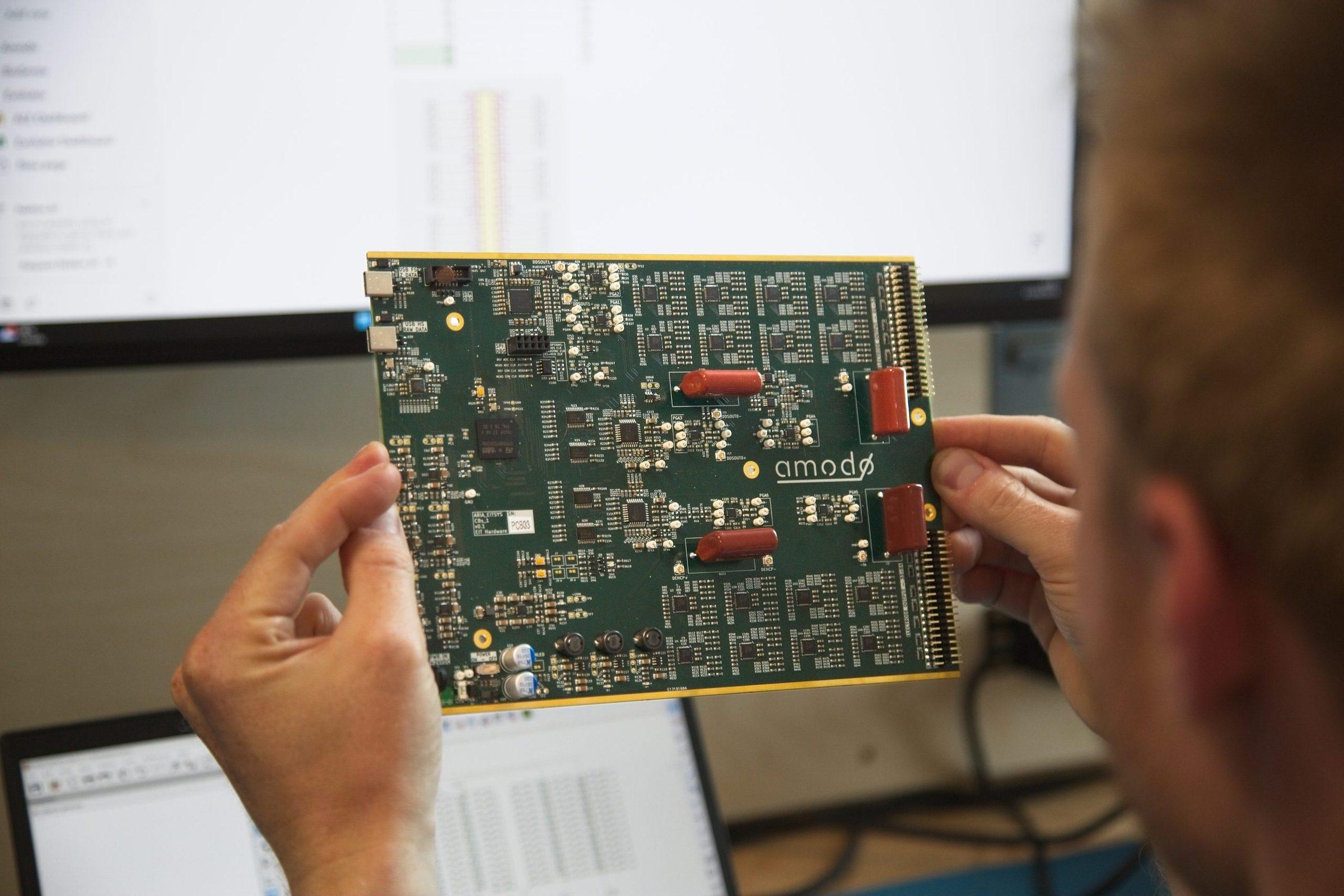
In Sheffield, there is the rare example of such a Cambridge-style consultancy that is making a name for itself, Amodo. It could become a force for change in the same way as the Cambridge consultancies.p43
The university as a talent enabler
From the report, p44
The challenge for any cluster to succeed is to build depth - companies, talent, knowhow and a level of excitement. Amodo helps to raise that bar. The University also plays an important role in nurturing the next generation of talent.p44
An important starting point is the encouragement given to academics to gain credit for other activities besides publishing papers, such as launching a spinout. A good example is Professor Chee Hing Tan, the Scientific co-founder of Phlux Technology. Before the University simplified the spinout process, he had tried at least twice to spin out companies but had given up due to bureaucracy and costs. He is now highly enthused. Another example is Professor James Marshall in the Computer Science Department, who co-founded Opteran Technologies in 2020, and is the Director of the newly established Centre for Machine Intelligence. Opteran has raised over £10M of seed funding from investors including IQ Capital in Cambridge.p44
The link with Arm Sheffield
The encouragement of this entrepreneurial mindset helped attract John Goodenough to leave Arm and return to the University as Professor of Microelectronic Systems. He had earned his PhD at Sheffield, stayed on as a lecturer and then set up his own consultancy, which he sold to Arm in 2000. Goodenough remained at Arm for over 20 years, rising to a senior VP position, during which period Arm’s Sheffield offices have grown from around 12 people to 250.p44
Goodenough therefore is in the rare position for a university professor of having spent most of his career at the UK’s leading technology company based both in Cambridge and Silicon Valley. With Arm next door as a major employer, there are opportunities for graduates of his courses to remain in the region.p44
To take advantage of these assets Goodenough is planning to create a centre of excellence in microelectronics that will propel Sheffield into the top echelon of microelectronic design and development in the UK and beyond. He also plans to mobilise a future manufacturing capability for advanced packaging of electronic systems which can serve niche markets like defence. His plans are helped by the fact that Sheffield hosts the UK’s National Epitaxy Centre for III-V Semiconductor research accessible to both academic and industry researchers. Spin-outs related to this include:p44
- Infinite Design: chip designs, now part of ARM.
 Phasefocus (opens in a new tab): imaging instruments, now part of Bruker.
- Phlux Technology (opens in a new tab): infrared avalanche photodiode.
- AegiQ (opens in a new tab): single photon light source.
 PyrOptik (opens in a new tab): quantitative temperature measurement.
- Pixel~Flo (opens in a new tab): microLED manufacturing.
Referring back to the factors which were important for Cambridge’s success, we see in the above the elements of timing such as returning to the University when the environment for spinouts has improved so much; the key contribution an individual can make to change the culture and raise the bar; and the impact that this is already having in terms of spinouts. When combined with other positive signals we have noted it gives hope that the momentum will only accelerate from here.p44
Capital is the key
From the report, p45
There is now more locally-available capital for Sheffield startups and scale ups. Mercia has a local office; Par Equity, headquartered in Edinburgh, opened its first office outside Scotland in Sheffield in 2023 before merging last year with northwest fund manager, Praetura, to become PXN; and the most recent arrival is Foresight, which manages the South Yorkshire Growth Equity Fund. Sheffield also boasts its own locally-grown private equity firm, Yorkshire AI plc, which plans to capitalize on opportunities in AI by taking advantage of its regional knowledge.p45
From coal mining to data mining
One company however that has built itself up without venture capital is 53North, an engineering consultancy established in 2013 and led by Tom Clayton. It harnessed its deep engineering domain knowledge to fast evolving AI-driven, data-led predictive maintenance analysis to expand into numerous high value markets.p45
Keen to exploit this opportunity, Clayton looked for a fast and secure route to finance the new business. This led to the decision to list on the Aquis Exchange as IntelliAM AI plc.p45
Tom argues that smart companies like IntelliAM, with a delivery track record, proof of value and a prestigious customer base are much better positioned than university spinouts with no product and no customers, to attract investment and be the agents of regional economic growth. A path others in the region could profitably follow.p45

Exploit a strong track record
“We all know the public markets are cautious, risk averse creatures, but if you have a strong track record, an expanding customer base and make a compelling business case with a clear return on investment, London will listen and even back you. Just as London has invested in steel and coal in the past.”p45
He encourages others saying, “If you’ve got the characteristics I talked about, use the public markets. The reality is, you’ve got all the domain expertise, you’ve got the product, you’ve got the customers, you’ve got the track history, you’re the one doing the pitches, the investors are the ones putting the money in, the nominated advisor (Nomad) is taking it to market and the legal team does the legals. All you need is the Nomad - picked from a short list of three - and a lawyer. Job done.”p45